
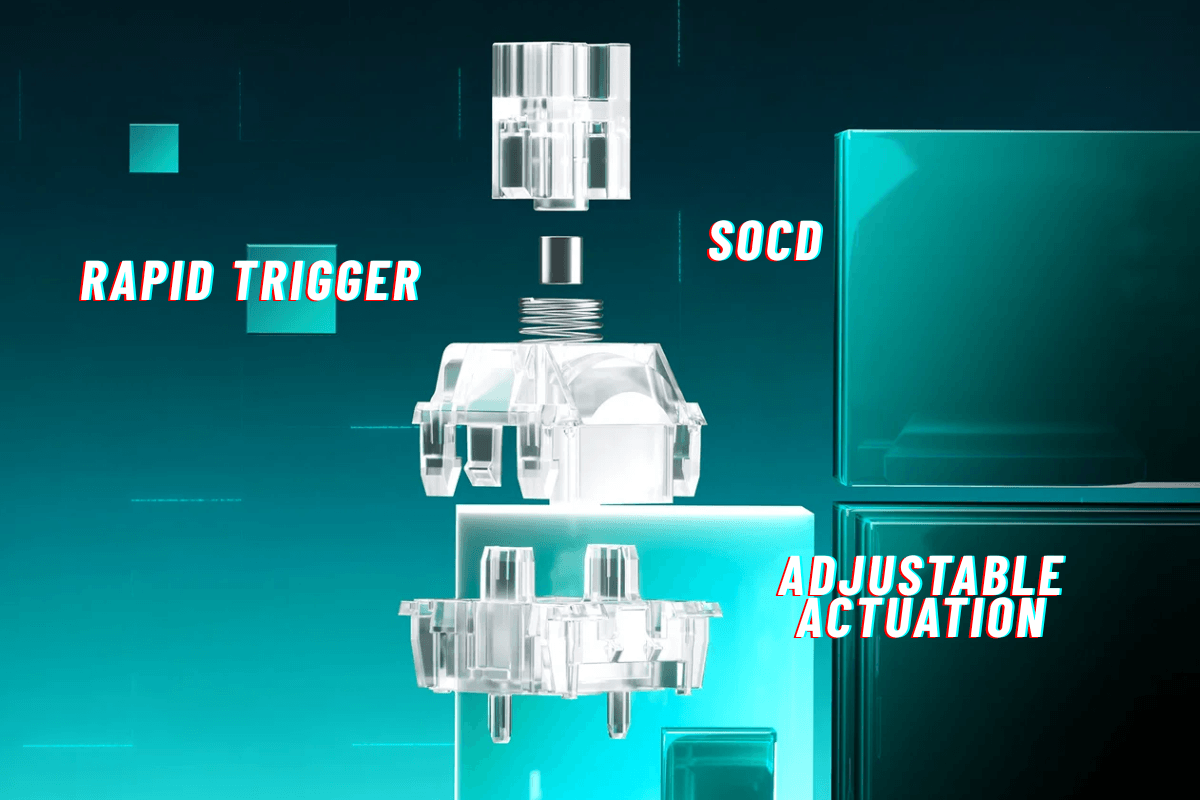
Los juegos competitivos son más exigentes que nunca, e incluso pequeñas mejoras en la respuesta de entrada pueden marcar la diferencia. Es por eso que funciones como Rapid Trigger, punto de actuación ajustable y SOCD se han vuelto cada vez más comunes en los modernos teclados de disparo rápido modelos, especialmente aquellos diseñados para juegos FPS de ritmo rápido.
Aunque estos términos pueden sonar técnicos, cada uno resuelve un problema diferente relacionado con la respuesta de las teclas y el movimiento. En esta guía, explicaremos qué son Rapid Trigger, el punto de actuación ajustable y SOCD, cómo funcionan y cómo pueden mejorar tu experiencia de juego.
¿Qué es Rapid Trigger?
Rapid Trigger es una función de teclado diseñada para detectar pulsaciones y liberaciones de teclas de forma más dinámica que los interruptores mecánicos tradicionales. En un teclado convencional, una tecla generalmente necesita recorrer más allá de un punto de actuación fijo antes de que se registre la entrada, y debe volver por encima de ese punto antes de poder registrarse nuevamente. Rapid Trigger elimina este requisito de reinicio fijo al detectar continuamente la posición de la tecla, lo que permite que el interruptor se active o se reinicie con movimientos muy pequeños.

Esto puede ser especialmente útil en juegos de ritmo rápido como los títulos FPS, donde el movimiento rápido y las pulsaciones repetidas de teclas son importantes. Por ejemplo, soltar y presionar una tecla de movimiento puede ocurrir más rápidamente con Rapid Trigger, lo que puede hacer que acciones como el counter-strafing se sientan más receptivas. Sin embargo, Rapid Trigger no hace automáticamente más rápido a todos los jugadores: simplemente te da un control más preciso sobre cuándo se activa y se reinicia una tecla, especialmente cuando se combina con interruptores de efecto Hall.
¿Qué es la actuación ajustable?
La actuación ajustable te permite cambiar cuánto debe recorrer una tecla antes de que el teclado registre una pulsación. Los teclados mecánicos tradicionales suelen tener un punto de actuación fijo, mientras que los teclados con actuación ajustable te permiten establecer el punto de activación según tu preferencia. Una distancia de actuación más corta puede hacer que las teclas se sientan más rápidas y receptivas, mientras que una distancia más larga puede ofrecer más control y reducir pulsaciones accidentales, lo que convierte a los teclados de actuación ajustable en una opción versátil para juegos competitivos.

Para los juegos competitivos, diferentes teclas pueden beneficiarse de diferentes configuraciones. Las teclas de movimiento como WASD pueden funcionar bien con un punto de actuación más corto para entradas más rápidas, mientras que las teclas menos utilizadas pueden configurarse más profundas para reducir activaciones no deseadas. La configuración ideal depende de tu estilo de juego y del juego que juegues, por lo que vale la pena experimentar hasta encontrar un equilibrio entre velocidad, control y precisión.
¿Qué es SOCD?
SOCD significa Direcciones Cardinales Opuestas Simultáneas, una función que determina cómo un teclado maneja dos entradas direccionales opuestas al mismo tiempo, como presionar A y D juntas o W y S juntas. Sin un comportamiento SOCD definido, estas entradas pueden crear señales conflictivas. Un teclado con procesamiento SOCD puede aplicar una regla específica, como priorizar la entrada más reciente, priorizar una dirección o tratar ambas entradas como neutrales.

SOCD se ha vuelto especialmente relevante en los juegos FPS competitivos, donde el movimiento preciso y los cambios rápidos de dirección pueden ser importantes. Al procesar de manera consistente las entradas opuestas, puede hacer que el comportamiento del movimiento sea más predecible y más fácil de controlar. Sin embargo, las reglas de SOCD pueden variar entre teclados y juegos, por lo que los jugadores deben entender cómo funciona esta función en su teclado de juegos específico antes de usarla en el juego competitivo.
Rapid Trigger vs. Actuación Ajustable vs. SOCD
Rapid Trigger, ajuste de actuación y SOCD son características relacionadas de teclados para juegos, pero resuelven problemas diferentes. Rapid Trigger se centra en la rapidez con la que una tecla puede activarse y reiniciarse, lo que resulta útil para entradas repetidas rápidas. El ajuste de actuación le permite elegir cuánto debe recorrer una tecla antes de registrarse, brindándole más control sobre la sensibilidad. SOCD se centra en cómo el teclado maneja entradas opuestas simultáneas, como A y D, lo que puede ser especialmente relevante cuando se utilizan interruptores de teclado para competitivos juegos y movimientos precisos.
| Característica | Función principal | Beneficio principal |
| Activación rápida | Detecta dinámicamente el movimiento de la tecla | Activación y reinicio más rápidos |
| Actuación ajustable | Cambia el punto de actuación | Mayor control sobre la sensibilidad de las teclas |
| SOCD | Procesa entradas opuestas | Movimiento direccional más predecible |
Estas funciones pueden trabajar juntas, especialmente en los modelos modernos de teclados con efecto Hall. Por ejemplo, puedes usar la actuación ajustable para afinar cuándo se activa una tecla, Rapid Trigger para hacer que los movimientos repetidos sean más receptivos y SOCD para gestionar entradas direccionales en conflicto. Sin embargo, tener las tres funciones no hace automáticamente que un teclado sea mejor. La combinación adecuada depende de tu juego, estilo de juego y capacidad para aprovechar cada ajuste.
Mejores ajustes para juegos competitivos
Para los juegos competitivos, los mejores ajustes son aquellos que equilibran velocidad, control y consistencia. Rapid Trigger puede hacer que las pulsaciones y liberaciones de teclas se sientan más receptivas, la actuación ajustable te permite ajustar con precisión la rapidez con la que se activan las teclas, y SOCD puede ayudar a gestionar entradas direccionales opuestas de manera más predecible.

Sin embargo, las distancias de actuación más cortas y los ajustes más sensibles no siempre son mejores. La configuración ideal depende de tu juego y estilo de juego, así que tómate un tiempo para probar diferentes ajustes y encontrar una configuración que se sienta rápida sin provocar pulsaciones accidentales. Al comparar los teclados gaming de GamePeripherals, busca un equilibrio entre capacidad de respuesta, ajustabilidad y rendimiento constante en lugar de simplemente elegir los ajustes más sensibles.

Dejar un comentario
Este sitio está protegido por hCaptcha y se aplican la Política de privacidad de hCaptcha y los Términos del servicio.