
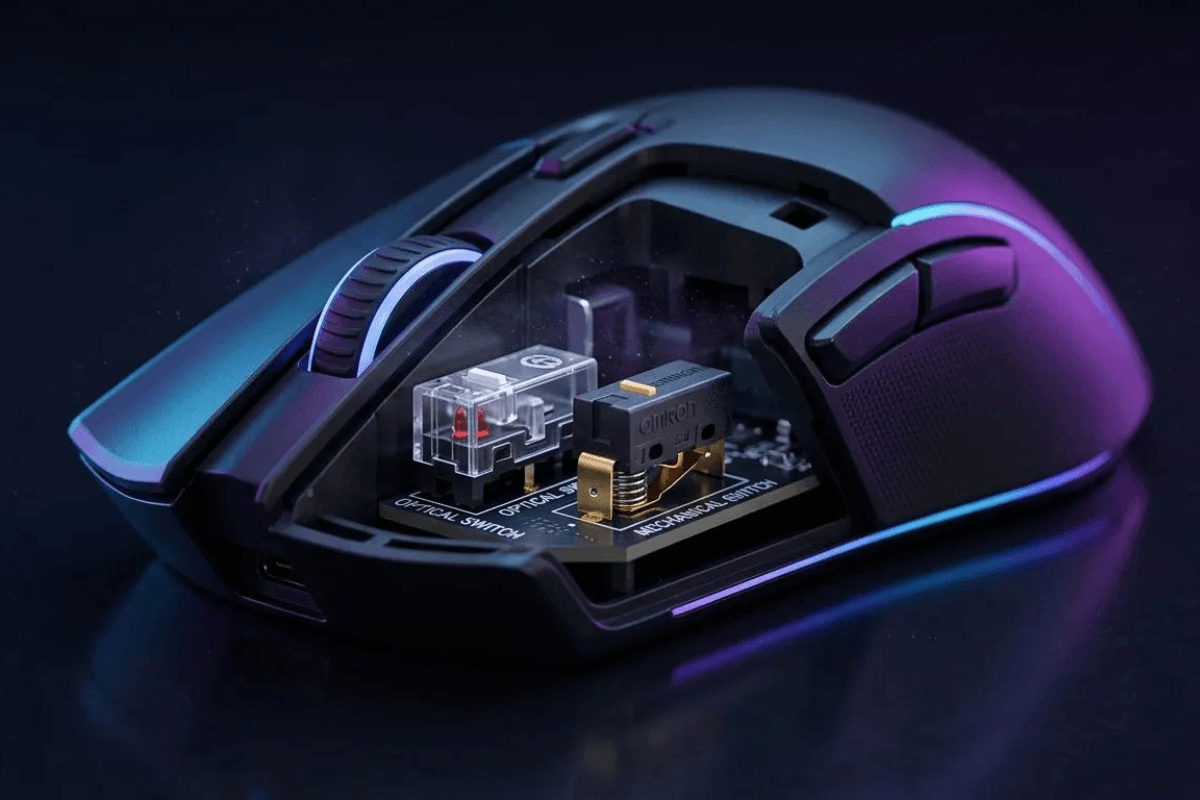
The switches beneath your mouse buttons play an important role in how every click feels and registers. Whether you are playing competitive FPS games, browsing the web, or working for hours, the switch design can influence feedback, responsiveness, and long-term reliability.
When comparing optical vs mechanical mouse switches, the main difference is how each type detects a click. Mechanical switches use physical electrical contacts, while optical switches use light-based sensing. Neither technology is automatically the best choice for every gamer, so understanding their strengths and limitations can help you choose more confidently.
What Are Mechanical Mouse Switches?
Mechanical mouse switches use a physical contact mechanism to register a button press. When you click, internal components move and electrical contacts close, allowing the mouse to detect the input.
This traditional design is widely used in gaming mice and is available in many variations. Different switches can offer distinct actuation forces, click sounds, tactile feedback, and rated lifespans.

For players who enjoy a crisp, familiar click, mechanical mouse switches remain a popular option. Their performance depends on the specific switch, mouse construction, firmware, and how the manufacturer implements the button mechanism.
What Are Optical Mouse Switches?
Optical switches detect actuation using a light-based mechanism rather than relying on the same electrical contact closure used by conventional mechanical switches. A button press changes the light path, allowing the sensor to register the click.
Because optical designs do not depend on physical electrical contacts for actuation, they can avoid contact-bounce behavior associated with traditional switches. However, the button still contains moving mechanical components, and its feel depends on the overall design.

Many modern gaming mice use optical mouse switches to provide consistent actuation and reduce reliance on conventional contact debounce. Exact performance and durability still vary by model.
Optical vs Mechanical: Key Differences
| Feature | Optical Switches | Mechanical Switches |
| Actuation | Light-based detection | Physical electrical contacts |
| Click Feel | Varies by design | Varies by design |
| Contact Bounce | No conventional electrical contact bounce | May require debounce handling |
| Durability | No actuation contact wear | Contacts can wear over time |
| Double-Click Risk | Avoids contact-bounce-related issues | Can develop contact-related issues |
| Gaming Performance | Depends on implementation | Depends on implementation |
| Availability | Common in many modern gaming mice | Widely available across price ranges |
The table highlights general differences rather than guarantees. A well-designed mechanical switch can perform extremely well, while an optical switch can still have a click feel that does not suit your preference.
Click Feel and Gaming Performance
Click feel is often more noticeable than the underlying technology. Some players prefer a firm, sharp click with clear feedback, while others like a lighter and more effortless button press.
Optical switches are sometimes marketed as faster because they do not require conventional electrical contact debounce. That can be an advantage in certain implementations, but it does not mean every optical mouse has lower total click latency than every mechanical mouse.

Overall responsiveness also depends on the mouse's firmware, button design, sensor processing, polling rate, and connection. When choosing among GamePeripherals gaming mice, compare the complete mouse rather than treating switch technology as the only performance specification.
For competitive gaming, a comfortable shape and reliable clicks are usually more important than selecting a switch type based solely on marketing claims.
Durability and Double-Click Issues
Mechanical switches can experience wear at their electrical contacts over time. Contact bounce is a normal characteristic of mechanical switching, and firmware typically uses debounce handling to prevent one press from being interpreted as multiple clicks.
As a switch ages or develops problems, unintended double-clicking may occur. However, not every mechanical switch develops this issue, and quality, usage, environment, and implementation all influence longevity.

Optical switches avoid the same electrical contact-bounce mechanism, which can reduce one common cause of unintended double-clicking. They are not completely immune to failure, though. Mechanical parts, button structures, sensors, and electronics can still develop faults.
Manufacturer click-life ratings can be useful for comparison, but they are laboratory specifications rather than guarantees of how long a mouse will last in everyday use.
Which Should You Choose?
Choose an optical-switch mouse if you value light-based actuation and want to avoid conventional contact-bounce-related issues. For example, the EWEADN Z7 MASTER is worth considering for gamers who prefer optical switches and a performance-focused wireless mouse. Its carbon-fiber design also makes it an interesting option for players who prioritize lightweight construction and a distinctive appearance.
If you prefer the familiar tactile feedback of traditional switches, the SKN ZhuQue JingTan offers a mechanical-switch alternative. Its carbon-fiber construction and lightweight wireless design make it suitable for gamers who want a responsive mouse while retaining the click feel associated with mechanical switches.
When comparing these two options, consider your preferred click feel, hand size, grip style, and overall mouse specifications. Neither switch type is universally better, so choose the model that feels most natural for your gaming setup.
FAQs
Are optical mouse switches faster than mechanical switches?
Optical switches can avoid conventional electrical contact debounce, but total click latency depends on the complete mouse implementation. They are not automatically faster than every mechanical model.
Can optical mouse switches double-click?
Optical switches avoid conventional contact-bounce-related double-clicking, but other hardware or electronic faults can still cause unintended inputs. They are not guaranteed to be failure-proof.
Which switches are better for everyday use?
Both are suitable for everyday use. Comfort, click force, noise, shape, and overall mouse quality are usually more important than the actuation technology alone.


Laisser un commentaire
Ce site est protégé par hCaptcha, et la Politique de confidentialité et les Conditions de service de hCaptcha s’appliquent.