
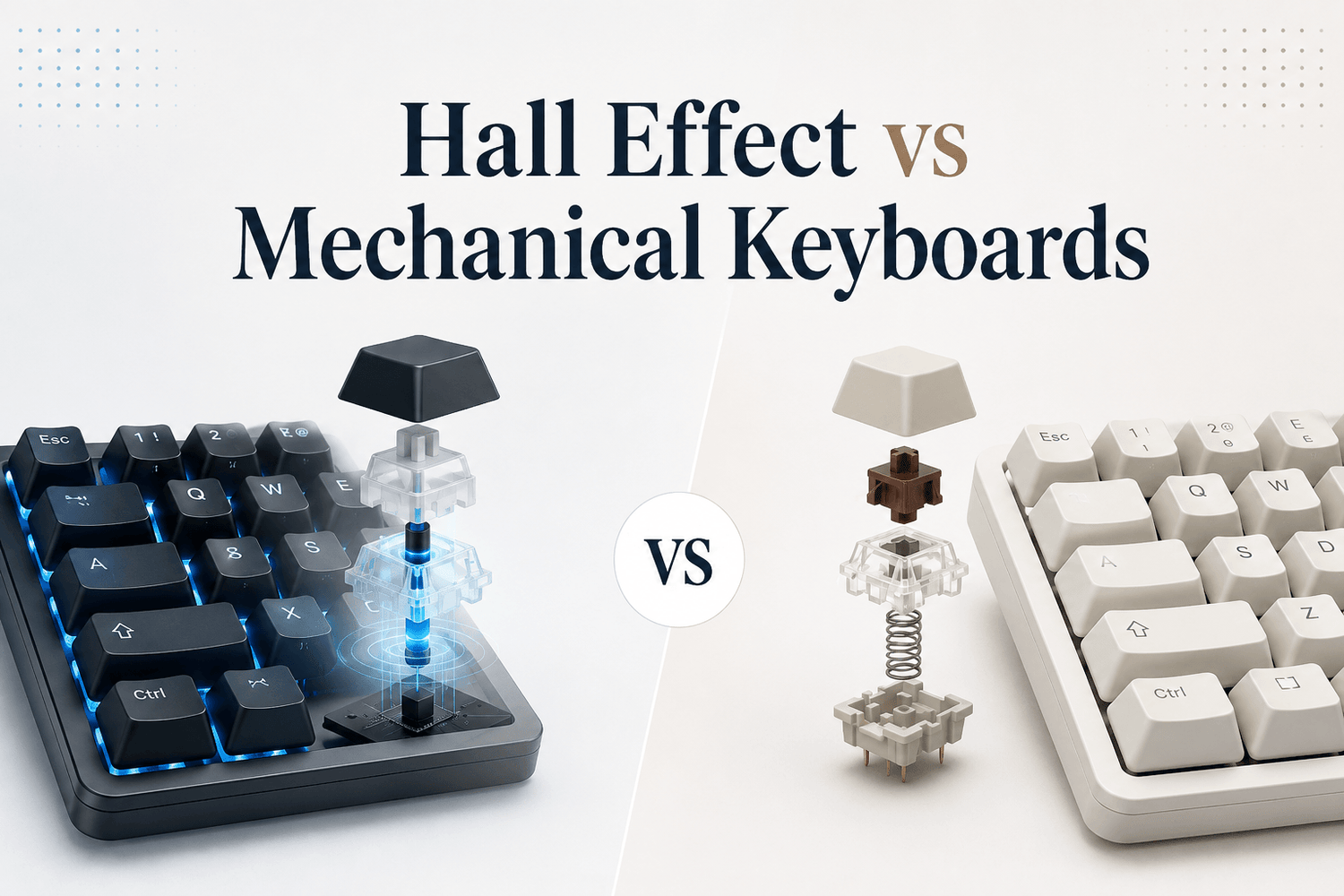
When comparing a Hall Effect vs mechanical keyboard for gaming, the biggest differences are actuation, reset behavior, switch feel, customization, and price. A Hall Effect keyboard is usually better for competitive players who want Rapid Trigger and adjustable actuation, while a traditional mechanical keyboard offers more switch choices and a familiar typing feel.
| Feature | Hall Effect keyboard | Mechanical keyboard |
| Input detection | Magnetic sensor | Physical contact |
| Actuation | Adjustable | Usually fixed |
| Rapid Trigger | Usually available | Usually unavailable |
| Switch variety | Limited | Extensive |
| Typing feel | Mostly linear | Linear, tactile or clicky |
| Customization | Mainly software | Hardware and software |
| Price | Usually higher | Wider price range |
| Best for | Competitive gaming | Gaming, typing and customization |
What Is a Hall Effect Keyboard?
A Hall Effect keyboard uses magnetic sensors to detect how far each key is pressed. In a typical magnetic switch, a magnet moves closer to a sensor on the PCB, allowing the keyboard to measure key travel continuously rather than waiting for metal contacts to close. This sensing method enables features such as adjustable actuation, Rapid Trigger, and, on some models, multiple actions from a single keypress. Although it is often called a magnetic keyboard, it still uses physical moving switches. The main difference is how the input is detected, giving gamers more control over when a key activates and resets.

What Is a Mechanical Keyboard?
A mechanical keyboard uses an individual mechanical switch beneath each key. Most traditional mechanical keyboard switches contain a stem, spring, housing, and metal contacts that close at a fixed actuation point to register input. Switches are commonly available in linear, tactile, and clicky designs, giving users a wider choice of feel and sound than most Hall Effect models. A mechanical gaming keyboard may not offer adjustable actuation or Rapid Trigger, but it can still deliver fast, reliable performance. Its mature ecosystem of switches, keycaps, layouts, and modification options also makes it appealing to gamers, typists, and keyboard enthusiasts.

Hall Effect vs Mechanical Keyboards: Key Gaming Differences
1. Rapid Trigger and Adjustable Actuation
A Hall Effect keyboard continuously measures how far each key moves, allowing users to adjust the actuation point through software. A shorter setting can make movement keys respond sooner, while a deeper setting can reduce accidental inputs. Rapid Trigger dynamically resets a key as soon as upward movement is detected, rather than waiting for it to pass a fixed reset point. This can help with counter-strafing, quick direction changes, and repeated inputs in games such as Valorant and CS2. However, setting a Rapid Trigger keyboard too sensitively may cause unintended keypresses, so the shortest setting is not always the best.

2. Polling Rate and Latency
Keyboard polling rate describes how often a keyboard reports input to the computer. A 1,000Hz keyboard reports up to once every millisecond, while an 8,000Hz model can reduce the theoretical reporting interval to 0.125 milliseconds. Many Hall Effect gaming keyboards advertise high polling rates, but this does not automatically guarantee lower real-world latency. Scan rate, firmware processing, actuation settings, USB implementation, and the game itself can all affect response time. Magnetic sensing avoids the physical contact bounce found in traditional mechanical switches, but a well-designed mechanical keyboard can still outperform a poorly optimized magnetic keyboard.

3. Switch Feel and Customization
Most Hall Effect switches have a smooth linear feel and focus on software-based customization. Users can adjust actuation, Rapid Trigger sensitivity, key behavior, and gaming profiles without replacing the switches. However, magnetic switch compatibility varies between brands, and a hot-swappable Hall Effect keyboard may not accept every magnetic or mechanical switch.

Traditional mechanical keyboard switches offer a much wider range of linear, tactile, and clicky options. Their established ecosystem also provides more choices for switches, springs, keycaps, plates, and other physical modifications. Hall Effect keyboards offer greater control over input behavior, while mechanical keyboards remain better for users who prioritize switch variety, typing feedback, sound, and hardware customization.
Which Keyboard Is Better for You?
The right choice in the Hall Effect vs mechanical keyboard debate depends on the games you play and the features you value most.
| User | Better choice |
| Competitive FPS player | Hall Effect |
| Valorant or CS2 player | Hall Effect |
| Rhythm game player | Hall Effect |
| Casual gamer | Either |
| Gaming and office use | Mechanical |
| Tactile or clicky switch user | Mechanical |
| Keyboard enthusiast | Mechanical |
| Budget buyer | Mechanical |
Choose a Hall Effect keyboard if you mainly play competitive FPS or rhythm games and want adjustable actuation, Rapid Trigger, and software-based control over key behavior. It is particularly useful for players who frequently perform counter-strafing, rapid direction changes, or repeated inputs. However, these features usually come at a higher price and may require time to configure properly.
Choose a mechanical keyboard if you play a wider variety of games, type frequently, or care about switch feel, sound, and hardware customization. Mechanical models also offer more tactile and clicky switch options, as well as a broader selection across different budgets.

For most casual gamers, either technology is fast enough. Layout, build quality, software, connectivity, and personal comfort may ultimately matter more than the switch technology itself.
FAQs
Are Hall Effect keyboards faster than mechanical keyboards?
Hall Effect keyboards can activate and reset sooner because they support adjustable actuation and Rapid Trigger. However, they are not automatically lower-latency than every mechanical keyboard. Firmware, scan rate, polling rate, and overall implementation also affect real-world response time.
Is Rapid Trigger worth it for gaming?
Rapid Trigger is most valuable for competitive FPS and rhythm games that require fast direction changes or repeated inputs. Casual gamers may notice less benefit. Very sensitive settings can also cause accidental inputs, so proper configuration is important.
Can you use mechanical switches in a Hall Effect keyboard?
Usually not. Hall Effect keyboards require compatible magnetic switches designed for their sensors and calibration system. A hot-swappable magnetic keyboard does not necessarily support traditional mechanical switches. A small number of dual-compatible models support both switch types, but you should always check the manufacturer’s compatibility list before replacing them.

Leave a comment
This site is protected by hCaptcha and the hCaptcha Privacy Policy and Terms of Service apply.